Why Your ChatGPT Content Sounds Weird (And How to Make It Sound Like Your Brand)

Let’s Talk About The Real Reason So Much ChatGPT Content Just Sounds… Generic.
You’ve probably seen it.
Or maybe you’ve even posted it yourself.
Or shook your head, thinking, “Why does this sound off?”
The grammar is perfect, the tone is friendly, and there’s nothing obviously wrong with it when you read through it.
And yet, you still wouldn’t post it.
Because it doesn’t sound like you or your brand. It doesn’t sound like something you’d actually write. It just sounds kind of stiff, and obviously AI-written.
This isn’t because ChatGPT is bad at writing. It’s actually very good at it.
It’s because most people are using it in a way that almost guarantees generic results.
Why ChatGPT Plays It Safe (And Your Content Pays the Price…)
When you open ChatGPT and type something like “Write an Instagram post about my product,” you’re giving it almost zero context. There’s no brand voice, no audience clarity, and no sense of how your brand actually communicates.
So ChatGPT does exactly what it’s designed to do in: play it safe
Safe content is forgettable content and forgettable content is something people scroll past.
ChatGPT isn’t trying to sound like a robot. It’s trying to sound generic, because without direction, that’s the safest option.
Why More Prompts Don’t Fix the Problem
A lot of people assume the solution is more prompts.
Longer prompts.
Bigger prompt packs.
Viral prompts that promise ‘‘instant’’ results.
But more prompts don’t help if they aren’t personalized.
You can have thousands of prompts and still end up with content that sounds nothing like your brand. Without any context, ChatGPT will always default to generic language and safe phrasing.
The One Change That Actually Makes ChatGPT Sound Better
Everything changes when you give ChatGPT a brand voice before you give it a hundred tasks. Before asking it to write captions, blog posts, or a sales page, it needs to understand a few things:
Who you are
Who you’re talking to
How your brand actually sounds
It also needs to know what you don’t sound like.
This is called a negative prompt. Specifically telling ChatGPT or any A.I. what you don’t want, so it actually gives you some results.
Think of this like hiring an assistant. You wouldn’t tell them to just write some posts for your business and then immediately disappear. Without any context. If you said to a brand-new marketing assistant: “Go write content for my business.” and then immediately disappeared…
They’d probably panic internally and write something very… safe… Something generic, because that can’t be wrong, right?
Same thing here.
ChatGPT needs direction, context, and examples.
Without those, it will always default to that same internet voice you’ve seen everywhere.
ChatGPT Is Basically A Baby
A very smart baby, yes.
But still a baby…
If you don’t teach it how to speak, how to behave, or what matters to you, you can’t be shocked when it says something off-brand or generic. And yet, this is exactly how most people use it.
“If you want ChatGPT to understand you and your brand, you have to “raise” it first.”
That doesn’t mean training it in a complicated or technical way.
But you do need to :
Define your brand voice
Set expectations
Give ChatGPT a role
Explain the exact outcome you want
Think of it like this: If ChatGPT is a baby, then your prompts are the parenting. Bad parenting equals bad results.
How to Get ChatGPT to Sound Like You
What actually works is combining structured prompts with clear brand context.
This means telling ChatGPT your tone, your audience and how they speak, your values, your goals, and the things you want it to avoid, like weird emojis, corporate language, or just unnecessary fluff.
Once your foundation is set right, it becomes easier. The content starts to sound natural.
And it finally sounds like something you’d publish without heavy editing.
Photo by Emiliano Vittoriosi on Unsplash
Why This Matters for Small Businesses
Your brand voice is one of the few things that sets you apart from all the other brands. If your content sounds like everyone else’s, uses the same phrases, and follows the same structure, people scroll past it, even if your product is genuinely good.
Using ChatGPT without brand alignment doesn’t save time. It just creates more work through rewriting, editing, and second-guessing.
And at that point, you might as well write it yourself.
What Changes When ChatGPT Understands Your Brand
The people who actually get results from ChatGPT don’t jump straight into asking it to write content with zero context. They pause, take a step back, and set things up properly first.
They define their brand voice once, use intentional prompts, and reuse that structure everywhere instead of starting from scratch every time.
That’s when ChatGPT stops feeling weird or generic and starts feeling like you.
When ChatGPT understands your brand, everything changes.
Your content sounds more natural, connects with people, and supports real engagement and sales.
That is when it finally becomes worth using.
Want This Set Up Done for You?
If you’re tired of:
ChatGPT sounding robotic
Rewriting everything it gives you
Guessing how to prompt it correctly
I created a simple, affordable, done-for-you prompt system that shows ChatGPT how to sound like your brand. It’s not just a list of prompts, but a guide that helps you personalize ChatGPT so it actually understands your business.
No fluff.
No 10,000-prompt overwhelm.
Just the part that makes ChatGPT sound human and sell.
If you want ChatGPT to finally feel like it’s working with you instead of against you, this is for you.
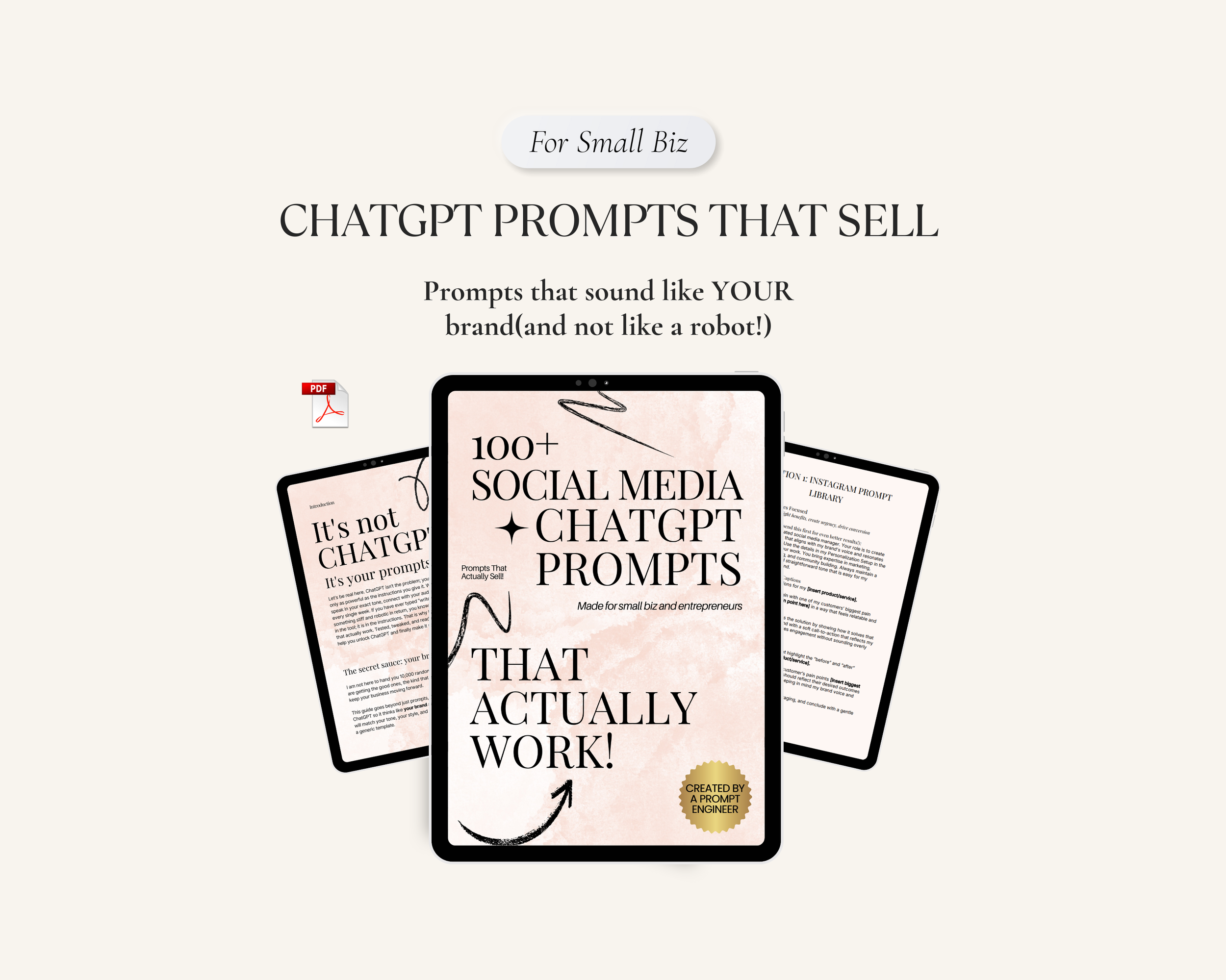
100+ ChatGPT Small Biz Prompts for Social Media (Instagram, TikTok, Pinterest, Email Marketing)
Let’s be real: you don’t need another giant list of ChatGPT prompts that sound robotic, generic, and end up forgotten in your downloads folder. What you actually need is a system that helps you create content that sounds like you and converts followers into buyers.
That’s exactly what this ChatGPT Social Media Prompt Pack delivers.
Created by a marketer and prompt engineer, this is a results-focused toolkit that teaches ChatGPT how to write in your unique brand voice so your content feels human, on-brand, and ready to sell.
Quick Context
This is a curated collection of 100+ ChatGPT prompts designed for small business owners who sell physical products, digital products, or services and want social media content that actually converts.
Instead of generic prompts that produce stiff replies, these prompts guide ChatGPT step by step to write content in your brand voice for Instagram, TikTok, Pinterest, and email marketing — whether you run an online shop, a physical store, or both.
Why This Works
Most ChatGPT prompt packs give you lists. This one gives you results.
These prompts are written to help ChatGPT sound like you, not a robot. Instead of guessing what to post or rewriting bland AI outputs, you get content that feels natural, engaging, and built to convert.
You don’t need to learn marketing from scratch. Each prompt guides ChatGPT step by step so the output is clear, on-brand, and ready to use across multiple platforms.
The result is a simple, repeatable system that saves time, removes overwhelm, and helps you show up online with confidence and consistency.
What You’ll Get
100+ proven ChatGPT prompts for social media posts, captions, and hooks
Organized by platform: Instagram, TikTok, Pinterest, and Email Marketing
Post types that convert: sales, engagement, education, storytelling, promotion, and authority-building
A quick setup guide that helps ChatGPT deliver your best content every time, in your brand voice
Preview of what’s inside:
Generic prompts:
“Write an Instagram post about my new product.”
→ Robotic. Bland. Easy to scroll past.
Our prompts:
“You are my expert social media strategist. Create an Instagram post about [insert product or service] in my brand voice. The tone should be [friendly / professional / playful]. The goal is to increase engagement and sales. Include a strong hook, three value-driven points, and a clear call to action.”
→ Specific. On-brand. Designed to convert.
How It Works
Purchase and download instantly. Open the PDF and follow the short setup steps. Then personalize any prompt, copy it into ChatGPT, and generate ready-to-post content in seconds.
Details
Instant digital download (PDF). You will receive this product immediately.
No physical item will be shipped
All sales are final due to the digital nature of the product
All rights reserved